Small Japanese Daily Habits for Everyday Wellbeing
Five gentle Japanese daily habits for wellbeing — from eating to 80% full and slow forest walks to morning movement, mindful tea, and finding your ikigai.
Table of contents
Small Japanese daily habits for wellbeing are simple, low-effort practices you repeat on an ordinary day: stopping a meal when you feel about 80 percent full, taking an unhurried walk among trees, moving your body for a few minutes each morning, turning a cup of tea into a real pause, and keeping a quiet sense of everyday purpose. None of them asks for special equipment, a subscription, or much time. You can try one tomorrow and see how it feels.
Several of these habits come from Okinawa, one of the regions the longevity research group Blue Zones studies for its unusually long, healthy lives. This is a beginner-friendly guide to the everyday versions of these practices — the ones anyone can borrow at home. It is not medical advice and won't replace care for a health condition; think of it as a small menu you can pick from.
Eat until you're about 80 percent full
Okinawans have a phrase for this: hara hachi bu, which comes from a Confucian teaching and translates roughly to "eat until you are eight parts out of ten full." Rather than eating until you feel stuffed, you stop at the point where you're satisfied but could still comfortably have a little more.
In practice, that often works out to about two-thirds of the portion you'd normally finish. The trick is slowing down enough to notice fullness before it arrives, since your stomach takes a while to catch up with your mouth. A few things that make it easier:
- Put your fork down between bites and check in with yourself halfway through the plate.
- Serve slightly smaller portions, and go back for more only if you're still hungry ten minutes later.
- Eat without a screen so you can actually feel when "enough" arrives.
Blue Zones links this gentle, unforced moderation to the long, healthy lives seen in Okinawa. If paying closer attention to when and how much you eat appeals to you, our guide to easing into intermittent fasting covers a related way to build awareness around meals.
Take a slow walk among trees
Shinrin-yoku, usually translated as "forest bathing," simply means spending unhurried time in a green, natural setting. Japan's Ministry of Agriculture, Forestry and Fisheries coined the term in 1982, partly to give people in fast-growing cities a restful counter to busy, screen-heavy days.
You don't need an actual forest. A tree-lined street, a city park, or a quiet garden all work. What matters is the pace: walk slowly, leave the phone in your pocket, and let yourself notice small things — the light through the leaves, the sound of the wind, the smell of the ground after rain. Twenty unhurried minutes is plenty to start with. There's no target distance and nothing to track.
Move for a few minutes each morning
Rajio taiso, or "radio calisthenics," is a short set of stretches and rhythmic movements that has been broadcast on Japan's NHK radio since 1928. The routine runs only about three minutes and comes in two versions, a gentler Taiso I and a slightly livelier Taiso II, so people of very different fitness levels can join in.
You don't have to follow the official routine to borrow the idea: a few minutes of easy, whole-body movement soon after you wake. Roll your shoulders, reach overhead, twist slowly side to side, rise onto your toes and back down. The value here is consistency and a small wake-up for your body, not intensity. Because it's short and needs no gear, it slots neatly onto something you already do, like the minutes while your coffee brews.
Turn a cup of tea into a pause
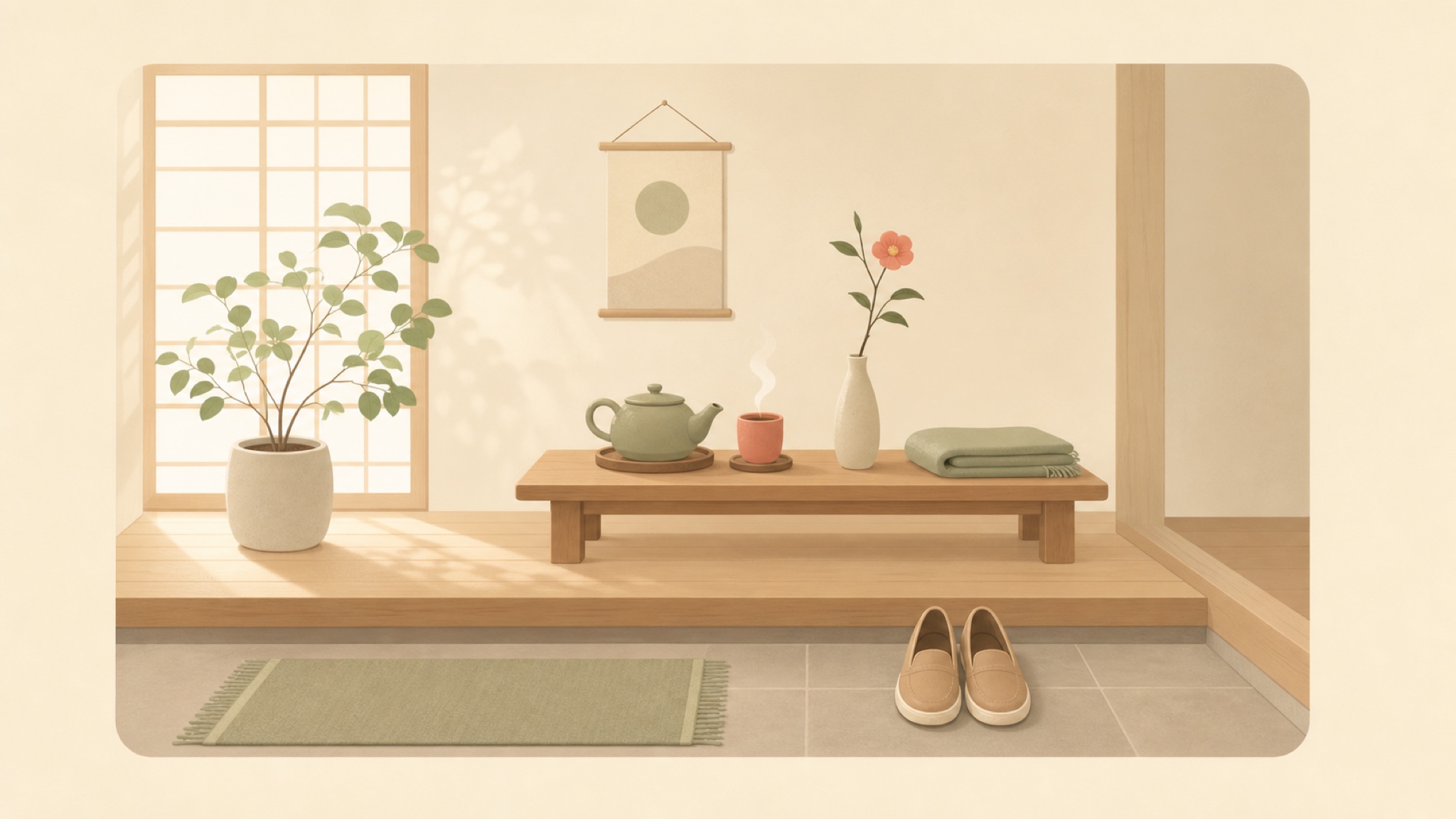
Green tea has a long place in Japanese daily life, from everyday sencha (loose-leaf green tea) to whisked matcha (powdered green tea). It naturally contains an amino acid called L-theanine, and Zen monks drank powdered green tea for centuries as an aid to focus during long stretches of meditation. You don't need to lean on any health claim, though, to get something from this habit.
The quieter benefit is the ritual itself. Heating the water, measuring the leaves or whisking the powder, waiting, and then drinking slowly all carve out a small, deliberate pause in the day. Think of it as a two-to-five-minute break you give yourself on purpose. If you already reach for tea or coffee, the change isn't adding a drink — it's drinking it without multitasking, even just once a day.
What is ikigai, and how do you find yours?
Ikigai is your everyday sense of having a reason to get up in the morning. The word joins iki ("to live") and gai ("worth" or "value"), and the Oxford English Dictionary defines it as "a motivating force; something or someone that gives a person a sense of purpose or a reason for living."
The Government of Japan describes ikigai as a joyful, everyday idea rather than a grand life mission. For many people in Japan it points to small, ordinary joys — tending a garden, sharing a meal, a hobby you look forward to. You don't have to overhaul your life to find yours. Notice the moments in an ordinary week when you lose track of time or feel genuinely glad, and try to make a little more room for them. If you'd like a soft place to begin, our piece on finding more joy in small everyday moments pairs well with this one.
How do you start without overwhelming yourself?
Pick one habit, not five. Trying to adopt every practice at once is the quickest way to drop all of them. Choose the one that sounds most appealing and give it a two-week trial before you add anything else.
Then attach the new habit to something you already do, so you don't have to remember it on your own — a technique often called habit stacking. A few examples:
- Do two minutes of stretching while the kettle heats.
- Take your slow walk at the same time each day, right after lunch.
- Say "about 80 percent" to yourself before your evening meal.
Keep the bar low enough that a tired day can't knock you off it. Two minutes counts. A short walk around the block counts. The aim isn't a flawless routine but a handful of small, repeatable choices that leave you a little calmer and steadier than you were before.
This article is for general information and self-care education only. It is not medical advice, diagnosis, or treatment. For questions about your health, talk to a qualified healthcare professional.