How Much Caffeine Is Safe for Your Heart?
Most healthy adults can safely have up to about 400 mg of caffeine a day, roughly four to five cups of coffee, with energy drinks the real risk to watch.
Table of contents
If you love your morning coffee and worry about what it does to your heart, here is the short version. Most healthy adults can take in up to about 400 milligrams of caffeine a day without harming their heart, roughly four to five 8-ounce cups of brewed coffee. The U.S. Food and Drug Administration treats 400 mg as the everyday safe ceiling, and as of July 2026 a scientific statement from the American Heart Association, published in the journal Circulation, reached a similar figure, noting that moderate coffee is tied to lower heart risk rather than higher. This article is for generally healthy adults; if you are pregnant, take heart medication, or live with an irregular heartbeat or high blood pressure, your safe amount is a conversation for your own doctor.
What's a heart-safe daily caffeine limit?
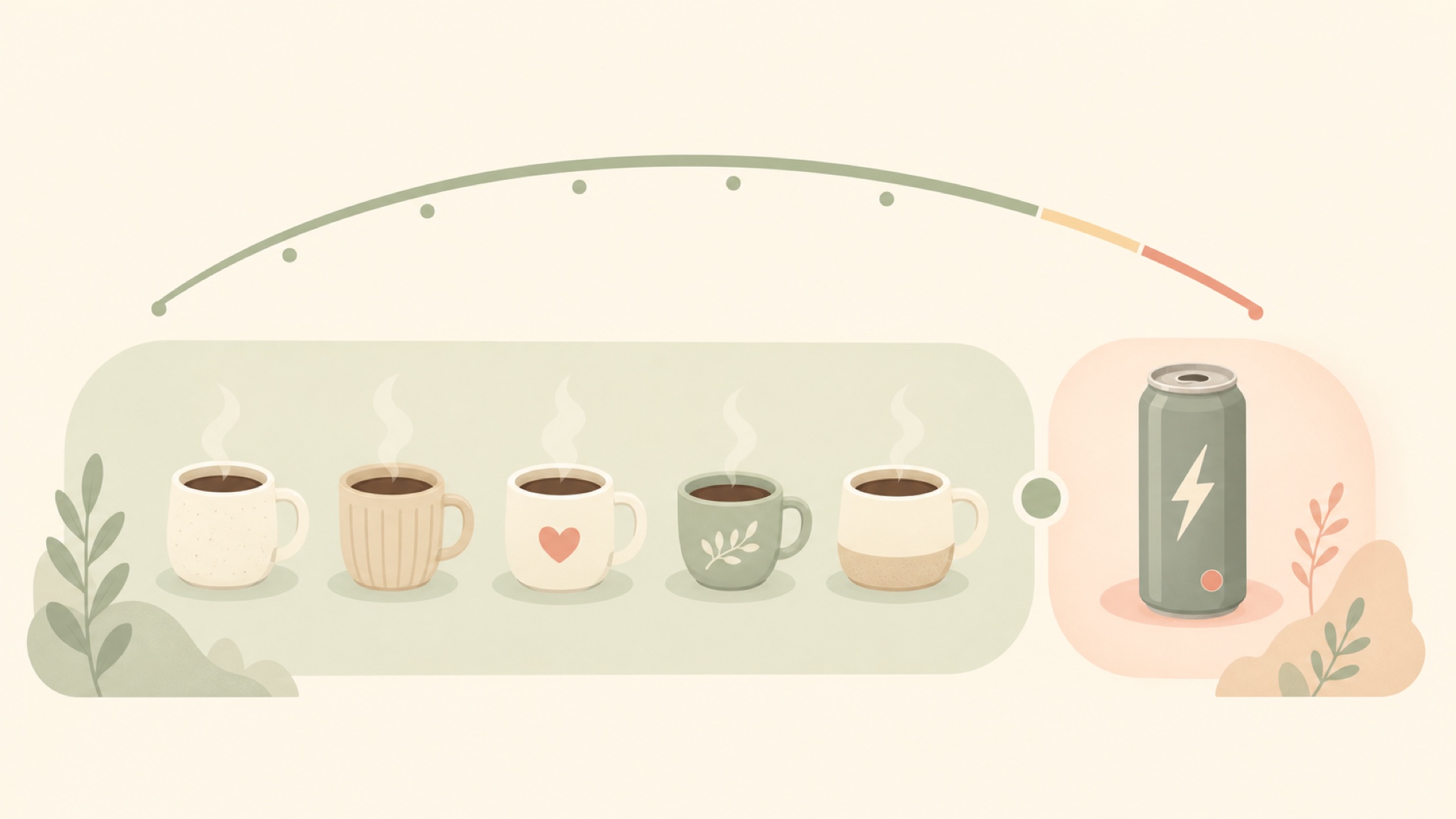
For most healthy adults, the ceiling sits at about 400 milligrams a day. The U.S. Food and Drug Administration lands on that figure, and it reads more clearly in cups than in milligrams. A standard 8-ounce cup of brewed coffee usually carries between 95 and 165 mg, a single shot of espresso around 63 mg, and a 12-ounce can of cola closer to 35 mg. Four mugs of drip coffee often bring you near the limit, while the same number of teas or sodas leaves room to spare. What you actually pour matters more than the size printed on the mug. A 2026 American Heart Association scientific statement in the journal Circulation lands in the same range, calling up to about 400 mg, roughly three to five 8-ounce cups, safe for most adults. At that moderate level, the statement tied coffee and caffeine to a lower risk of several heart conditions, including coronary heart disease, stroke, heart failure, and even atrial fibrillation, along with high blood pressure and type 2 diabetes. Its authors are careful to frame that as an association drawn from observational research, not proof that coffee itself earns the credit.
Does caffeine trigger palpitations or AFib?
For most people drinking normal amounts, no. A scientific statement from the American Heart Association, published in July 2026, reported that one to three cups of coffee a day showed no increased risk of atrial fibrillation, the most common type of irregular heartbeat, and linked everyday coffee to a lower risk of heart failure and stroke. That cuts against the old worry that coffee makes the heart skip. The same statement did flag one small caveat: caffeine was associated with slightly more premature ventricular contractions, or PVCs, the harmless extra beats most hearts throw now and then. Caffeine is still a stimulant, though, and some people feel it more than others. A racing or fluttering sensation after two cups is your body talking, and when that keyed-up feeling shows up, slowing your breathing to settle your nervous system tends to help more than gritting through it.
Where the real risk shows up
Trouble climbs with the dose and with whatever the caffeine is mixed into. The same July 2026 statement singled out high-caffeine energy drinks and energy shots as its biggest concern, warning they can push intake well past moderate levels. These drinks can carry three to four times the caffeine of regular coffee, often stacked with sugar, and have been tied to higher blood pressure and irregular rhythms. The statement also cautions that higher doses of caffeine push blood pressure up noticeably, and the effect is stronger for people who already run high. The FDA adds that very large, fast doses near 1,200 mg can cause serious effects such as seizures. Even the extras count; the heart association points out that loading coffee with syrup and cream likely chips away at its benefits.
Finding your own comfortable amount
Caffeine clears each body at its own speed, so watching your own signals beats chasing one number. Keep a rough daily tally, the same way you might track how much water you actually drink, and give yourself about six hours between your last cup and bedtime so it does not quietly steal your sleep. Treat a pounding heart, shaky hands, or a wired-but-tired feeling as a cue to ease off rather than push through. If your reaction feels bigger than a normal cup should cause, raise it with a clinician who knows your history. For most people, a couple of everyday cups is something the heart handles without any drama.
This article is for general information and self-care education only. It is not medical advice, diagnosis, or treatment. For questions about your health, talk to a qualified healthcare professional.