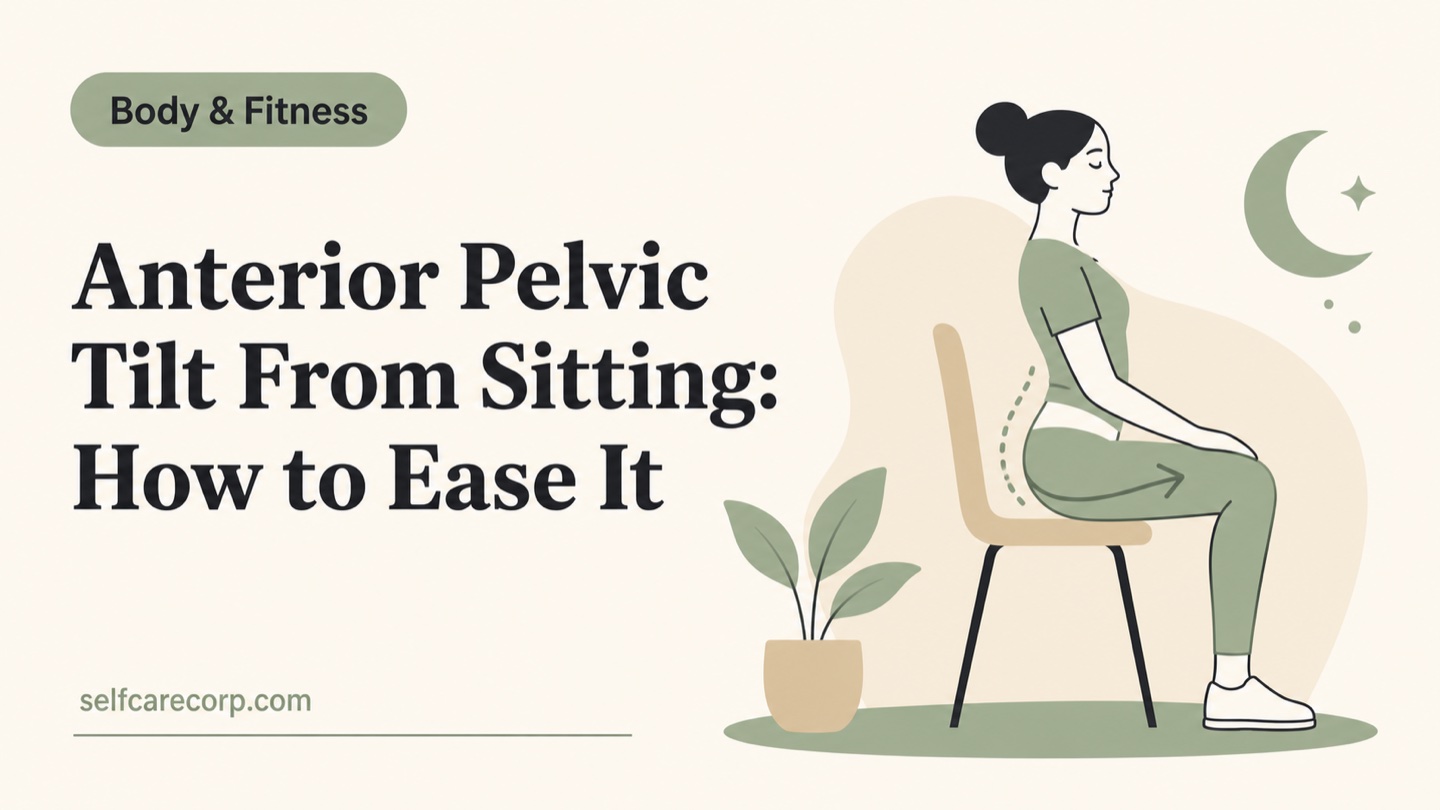
Anterior Pelvic Tilt From Sitting: How to Ease It
Sitting keeps hip flexors short and glutes quiet, tipping the pelvis forward. Simple stretches, glute work, and standing breaks help ease anterior pelvic tilt.
Table of contents
Anterior pelvic tilt is when the top of your pelvis rotates forward and down, which deepens the curve in your lower back and makes your backside stick out a little. If you spend most of the day in a chair, this is a common shape to settle into. Cleveland Clinic points to prolonged sitting as the most common reason a pelvis tips too far forward, because the muscles at the front of your hips stay short while the ones that should hold your pelvis level go quiet. You ease it the same way it forms: loosen what's tight, wake up what's weak, and break up long stretches of sitting. This is general wellness guidance for everyday desk-sitters, not a diagnosis, and ongoing pain deserves a proper look from a professional.
What anterior pelvic tilt actually means
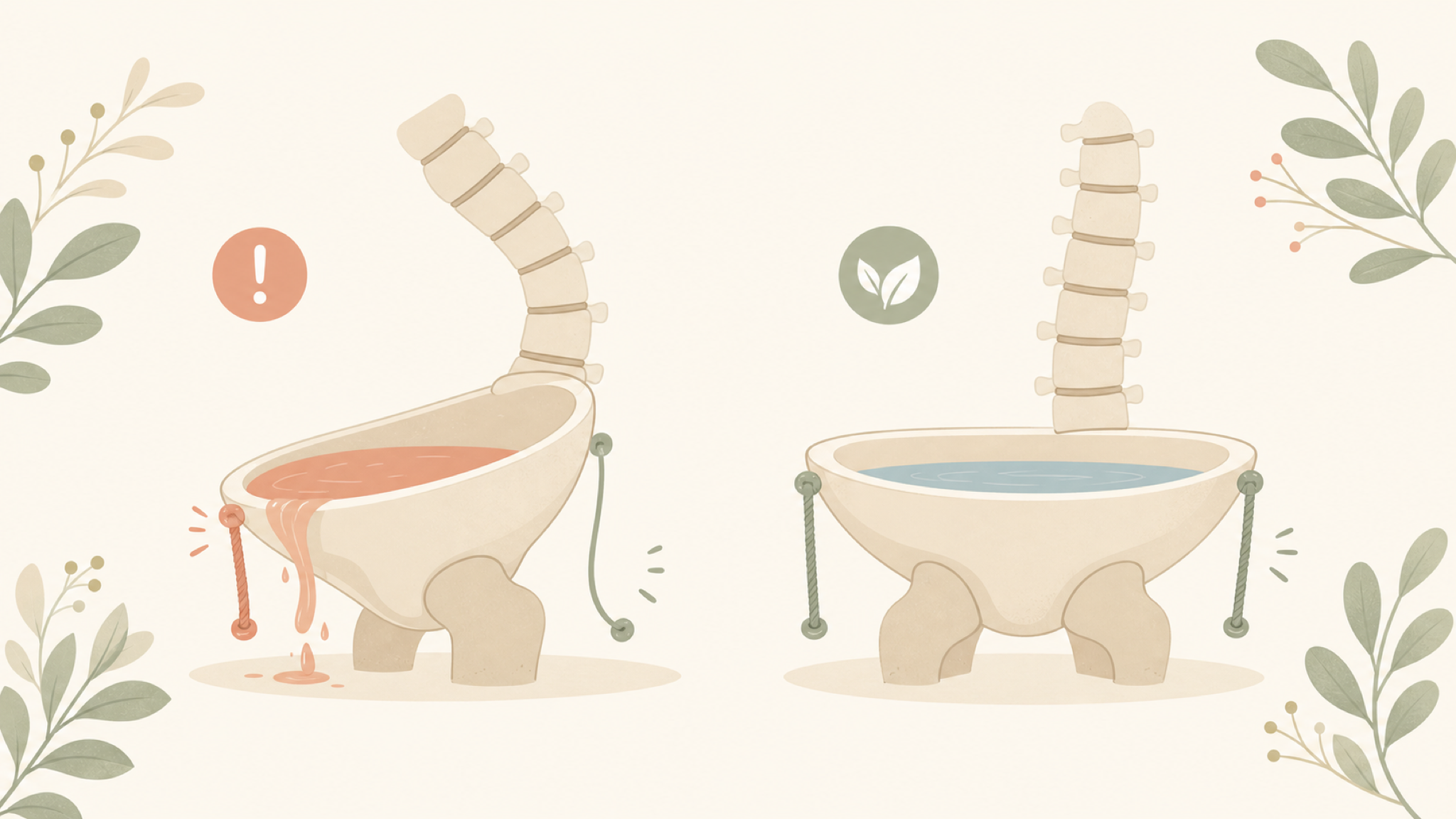
Picture your pelvis as a bowl of water. Held level, the water stays put. Tip the bowl forward and the water spills out the front - that forward tip is anterior pelvic tilt, and it pulls your lower spine into a deeper arch that clinicians call lumbar lordosis (the natural inward curve of the lower back).
A small forward tilt is normal, and it doesn't mean something's broken. A study of pain-free adults indexed on PubMed found that roughly 85% of men and 75% of women stood with some anterior tilt. So a perfectly flat pelvis isn't the target. The work is easing a tilt that's gone far enough to leave you stiff or sore.
Why sitting tips your pelvis forward
When you sit, your hips stay bent near 90 degrees for hours. The muscles at the front - your hip flexors, a group that includes the iliopsoas and rectus femoris - sit shortened that whole time. Do it day after day and they adapt to being short, so they keep tugging the front of your pelvis down even after you stand.
The muscles behind go slack in response. Cleveland Clinic notes that sitting weakens the glutes, hamstrings, and abdominal muscles that would otherwise keep the pelvis level. Physical therapists have a name for this front-tight, back-weak setup: lower crossed syndrome. Tight in front, quiet behind, and the pelvis drifts forward.
How do you know if you have it?
A quick mirror check gives you a rough read. Stand sideways to a mirror, relax your posture, and look at your profile. With a noticeable tilt, your lower back arches more than a soft curve and both your belly and backside push out when you're not trying. Some people spot that their belt sits lower in front than in back.
This is a self-check, not a diagnosis. A forward tilt on its own isn't cause for alarm - most pain-free adults have some. What matters more is how you feel: a lower back that tightens after long sitting, hips that feel stuck, or an ache that eases once you get up and walk. If any of that sounds familiar, the moves below give you somewhere to start.
The muscles to loosen and the muscles to wake up
Easing anterior pelvic tilt comes down to a simple trade: stretch the muscles that got short from sitting, and strengthen the ones that got lazy. Here's the split most routines follow.
| Muscle group | What sitting does | What to do |
|---|---|---|
| Hip flexors (front of hip) | Shorten and tighten | Stretch to lengthen |
| Lower back muscles | Overwork to hold the arch | Release gently |
| Glutes (buttocks) | Weaken from disuse | Strengthen |
| Abdominals and core | Go slack | Strengthen |
| Hamstrings (back of thigh) | Lose tone | Strengthen |
You don't need all five in one session. Two stretches for the front and two strengthening moves for the back and core, done three or four times a week, cover the trade.
Simple moves to try at home
Four moves map onto that trade. Go slowly, keep everything pain-free, and back off anything that pinches.
Kneeling hip flexor stretch
Kneel on one knee with the other foot flat in front, both legs bent near 90 degrees. Tuck your tailbone under, squeeze the glute on the kneeling side, then ease your weight forward until you feel a stretch across the front of that hip. Hold for 30 seconds to a minute, then switch sides. This is the front-of-hip release most guides start with.
Glute bridge
Lie on your back, knees bent, feet flat and hip-width apart. Press through your heels and lift your hips until your body forms a straight line from knees to shoulders, squeezing your glutes at the top. Lower slowly. Aim for 10 to 15 reps. It wakes up the glutes that sitting puts to sleep.
Posterior pelvic tilt
Stay on your back with knees bent. Flatten your lower back into the floor by rolling the top of your pelvis backward, as if tucking your tailbone. Hold 5 seconds, release, and repeat 10 times. It teaches your body the opposite motion of the forward tilt.
Dead bug
Lie on your back, arms reaching toward the ceiling, knees bent over your hips. Keeping your lower back pressed down, slowly lower one arm overhead and the opposite leg toward the floor, then return and switch. Do 8 to 10 per side. It builds the deep core that helps hold your pelvis steady.
Fixing the sitting, not just the muscles
Stretches help, but they're fighting uphill if you sit still for eight hours straight. The bigger lever is breaking up the sitting itself. Set a reminder to stand every 30 to 45 minutes, even for a short lap to the kitchen and back. While you're up, run through the standing version of that hip flexor stretch, or simply squeeze your glutes ten times.
Check your setup, too. Aim for hips level with or slightly above your knees, feet flat on the floor, and your screen near eye level so you're not perching forward. None of it needs to be perfect. Moving often beats any single stretch.
Building a movement habit is its own small skill. If getting started is the hard part, the approach in our guide on enjoying hard tasks without forcing them helps, and the start-tiny thinking behind a daily writing habit works just as well for a two-minute stretch routine.
When is it worth seeing a professional?
See someone if pain is sharp, spreading, or hanging around past a few weeks of gentle movement, or if it comes with numbness, tingling, or weakness in your legs. A physical therapist can watch how you actually move and hand you a routine built for your body instead of a generic list. Cleveland Clinic notes that most cases respond to stretches and exercises, with surgery kept for rare, severe situations that don't improve with therapy.
There's no prize for pushing through pain. Treat these moves as a gentle nudge back toward easy, comfortable movement, and give it time - most routines show change over a span of weeks, not days. Small, steady, and kind to yourself beats any dramatic overhaul.
This article is for general information and self-care education only. It is not medical advice, diagnosis, or treatment. For questions about your health, talk to a qualified healthcare professional.